- Interference, diffraction and polarization establishes the wave nature of light and can be explained on the basis of wave theory
- photoelectric effect and compton effect are explained on the basis of quantum theory of light which establishes that quanta behaves like corpescules.
- Louis de Brogli proposed that idea of dual nature i.e., wave particle duality should be extanded to all micro particlesi.e., wave and corpescular nature should be associated with each particle.
- According to him material particles might have dual nature same as that of light.
- He suggested that moving particle whatever is its nature , has wave properties associated with it.
- Wavelength λ associated with any particle of momentum p is given by
λ=h/p=h/mv
where h is the Plank's constant. - From Plank's theory of radiation , energy of photon is given by
E=hν = hc/λ
therefore λ=hc/E
From special theory of relativity
E=mc2
mass of photon is m=hν/c2
momentum of photon is
mc=p=hν/c = h/λ
therefore p=h/λ
or, λ=h/p - Thus what is true for energy packet (photon) is also true for material particle. Thus, for particle of mass m moving with velocity v , we have p=mv and de Brogli wavelength associated with it is
λ=h/mv
where m is the relativistic mass of the particle - If m or v is large the de Brogli wavelength associated with a material particle would be small.
- The de Brogli wave associated with a material particle or photon of any charge associated with it can also be calculated. Thus we know that
K=mv2/2
therefore mv=√(2mK)
λ=h/√(2mK) - If a charged particle carrying a charge q is accelerated through a potential difference V volts, then kinetic energy K=qV
Therefore be Brogli wavelength of charge particle for charge q and accelerated through a potential difference of V volts is given by
λ=h/√(2mqV)
Thursday, December 30, 2010
de Brogli wavelength


Friday, December 24, 2010
One Dimensional Oscillator (small oscillations)
- Consider a system with one degree of freedom and one generalized co-ordinate q. For small displacement from the equilibrium we can expand potential energy function using taylor series expansion about the equilibrium and we will only consider the lowest order terms. So expanding PE function V(q) we have

where derivativesare evaluated at the equilibrium position q=q0 and at equlilbrium (∂V/∂q)0 = 0 - V(q0) is potential energy at equilibrium and can be taken as zero, if the origin of potential energy is shifted to be at minimum equilibrium value.
This implies that

putting second derivative term in bracket equal to k and shifting origin to q0=0 we have
V(q)=kq2/2
and k is the positive parameter at the position of stable equilibrium. - If generalized co-ordinates does not involve time explicitely , the K.E. is then homogeneous quadratic function of generalized velocities, or,.


and equation of motion is

Sunday, December 19, 2010
Stable and unstable equilibrium
First consider the figures given below

Potential energy about point of stable equilibrium
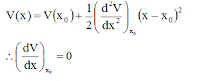
Suppose the particle is slightly displaced from point of stable equilibrium executing small oscillations then potential energy function can be expressed in the form of Taylor - series expansion i.e.,

- Above are the plots of potential energy as a function of x , for a particle executing bound and unbound motion.
- At x0=0 slope of potential energy curve dV/dx is zero. this implies that F = 0 i.e.,
F = -dV/dx = 0 (1)
and a point particle placed at such a point with zero velocity will continue to remain at rest. - At point x0 in figugure (a) at which potential energy has a minimum , if the particle is displaced then the force F = -dV/dx will tend to return to it and it will oscillate about the equilibrium point, performing bound motion. These points are called points of stable equilibrium.
- If the particle is displaced slightly from the equilibrium x0 in figure (b) , then it will be acted upon by the force
F(x) = -(-dV/dx) = dV/dx (2)
which will tend to push away the particle from equilibrium point , when released. Such points are called points of unstable equilibrium.
Potential energy about point of stable equilibrium
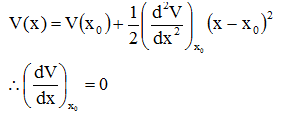
Suppose the particle is slightly displaced from point of stable equilibrium executing small oscillations then potential energy function can be expressed in the form of Taylor - series expansion i.e.,
Subscribe to:
Posts (Atom)
